
Goodhart's Law: When the Target Eats the Measure
The number improved. The business got worse. Nobody lied to you — you paid them to do this.
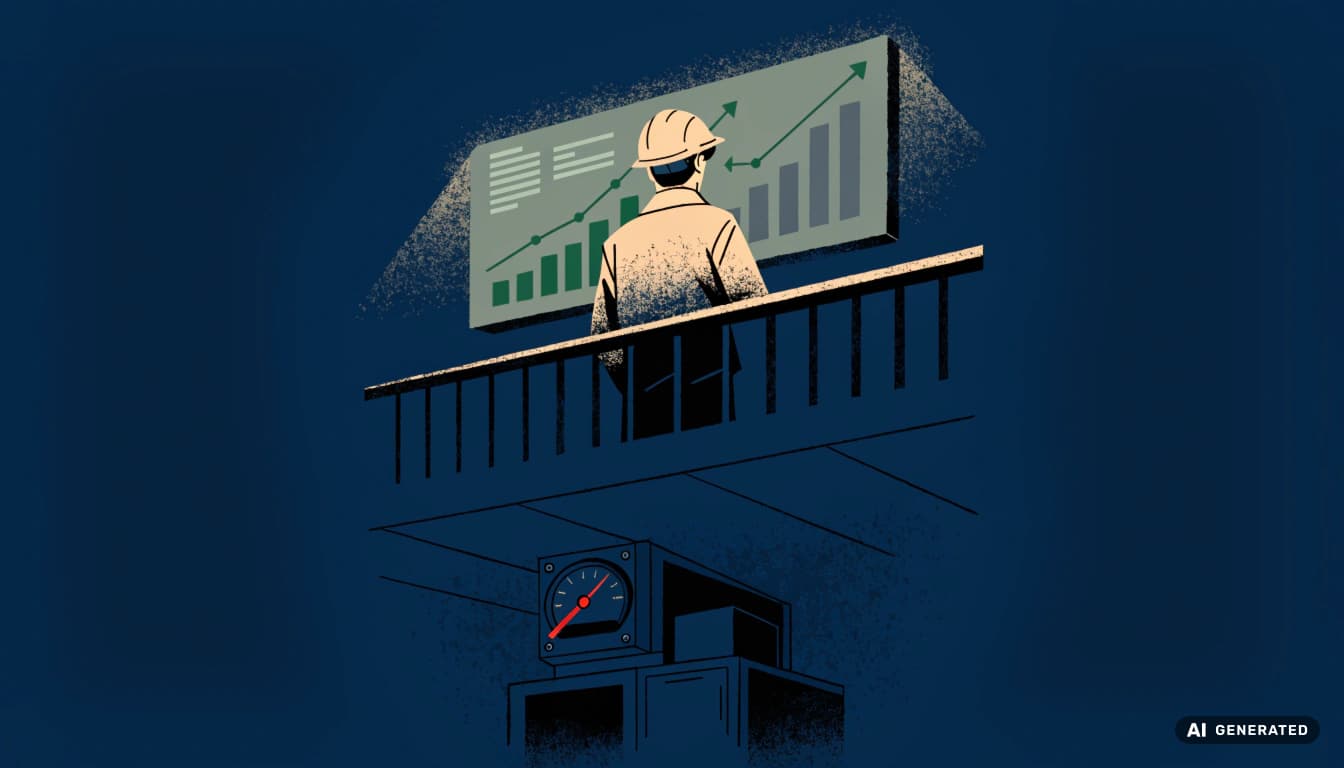
At Custom Plastic Coated Fabrics, I watched my own sales forecast for the reassurance a forecast is supposed to give.
Calls made. Deals in the pipeline. The numbers came in every week and the numbers looked fine.
The cash flow didn't. It kept getting worse while the forecast kept getting healthier, and for longer than I'd like to admit, I trusted the forecast.
Here's what was actually happening. The forecast had become the thing my sales team got measured on. So the inputs got managed. Calls were logged that never happened. Deals were reported at stages they'd never reached.
Nobody thought of it as cheating. They thought of it as hitting their numbers.
The forecast was supposed to predict cash. Instead it predicted what I wanted to hear. And the gap between those two things came due — in the bank account, where gaps always come due.
In 1975, a British economist named Charles Goodhart wrote down something that should be stencilled on every shop wall next to the safety record:
"When a measure becomes a target, it ceases to be a good measure."
The moment you attach pressure or reward to a number, people stop serving the thing the number represents and start serving the number. Not because they're dishonest. Because they're rational, and you told them what winning looks like.
I saw it at Home Depot before I knew it had a name. Head office decided store cleanliness was going to be measured and pushed. Reasonable — nobody buys lumber from a store that looks abandoned. Except the people doing the cleaning were the salespeople. Aisles got spotless. Sales dropped. The metric went up while the thing the metric existed to protect, sales, went down, and everyone involved was doing exactly what they'd been told.
If you think this is an old-economy problem, it's happening right now at the most sophisticated companies on the planet. Through 2026, firms have been pushing employees to use AI coding tools as hard as possible — some rewarding raw usage, one large tech company literally running an internal leaderboard for it. The result, per one analysis of 2,000+ companies: only about 18% of that AI spending translated into shipped product reaching real users. People were asking the AI to check the weather to hit their usage targets.
Same law. New costume. The measure became the target, and the target ate the measure.
You're probably thinking: so what, I should stop measuring?
No. The answer to a gamed measure is never not to measure. Run a shop on vibes and you'll lose it faster than you'd lose it to a bad dashboard.
The other objection I hear on shop floors: "My people wouldn't game the numbers." Here's the uncomfortable part — gaming doesn't feel like gaming from the inside. It feels like prioritizing. The salesperson cleaning an aisle isn't defrauding anyone. The rep logging an optimistic deal stage is being a team player. Goodhart's Law doesn't need bad actors. It just needs pressure and a number.
Three moves protect a measure from becoming a casualty.
Pair every target with the outcome it's supposed to protect
A number alone can be gamed quietly. A pair exposes the gaming. Machine utilization and on-time-in-full. Forecast accuracy and cash conversion. Cleanliness score and sales per labour hour. If someone hits one while the other slides, you don't have a performance story — you have a Goodhart story, and now you can see it.
At U-Flow, this is the closest thing I have to proof. We took gross margin from 25% to 38%, and the number never got gamed — because margin wasn't a scoreboard we watched, it was the paired outcome of process metrics the team actually worked. The target and the truth pointed the same direction. Nobody had anything to hide.
Review behaviours, reward outcomes
Wrote about this in July: the number on the board is already history. Use leading measures to steer the daily work, but tie recognition to the real outcome the business needs. When the reward sits on the input, the input gets manufactured.
Retire metrics before they calcify
Every measure has a shelf life. The longer a number carries pressure, the more creative the responses to it become. When a metric has been a target for a year, assume it's telling you less than it did on day one — and check it against reality on the floor.
Which brings me to the one that still bothers me. A client's shop had a safety program that graded out fine. Good numbers, clean reports. Then you walked the floor and saw open-toed shoes around the equipment.
The metric measured reporting. It had stopped measuring safety a long time ago.
The dashboard isn't the business. The moment you forget that, the dashboard makes sure you never find out.
One next step: Take your single most-pressured metric — the one your team knows you watch — and write down, in one sentence, the real outcome it exists to protect. Then pair it: put that outcome beside it on the same page, same review, same conversation. If hitting the number while the outcome slides would currently be invisible to you, you've found your gap. Fix that this week.
Further reading:
- The Tyranny of Metrics — Jerry Z. Muller (Princeton University Press, 2018). The book-length case for why measurement obsession corrupts the work it claims to improve.
- Obliquity — John Kay (Profile Books, 2010). Why the most important goals are best achieved indirectly — the deep logic under Goodhart.
- The Goal — Eliyahu M. Goldratt (North River Press, 1984). The original operator's lesson that local efficiencies are not the goal; throughput is.