
How the Margin Audit Works
Who this is for

Owners of manufacturers, fabricators, building-component plants, construction companies, and oilfield service companies that run their own shop, fleet and crews. $5M to $100M in revenue, 25 to 200 people across all shifts, across Alberta and Western Canada. Usually one of two things is true: you're busier than ever and earning the same, or you've moved up to the CEO seat and still get pulled back onto the floor.
Who it isn't for
Distributors, dealers, agents and engineering firms: there's no production floor for me to work on. Companies where the decisions sit with a parent company or an investor board. And companies that already have a strong COO running an improvement system on the floor. I'd only be duplicating them.
The Margin Audit

One day on site. I talk with you, finance, operations, sales and design leads and the supervisors. I walk the plant and the yard, and I sit in the meetings your team already runs. Then one day off site with your financial statements and job costing.
Within 10 business days you get a written report with three things: a verified EBITDA baseline, normalized so the measurement is fair to both sides; your three biggest margin gaps, each with a dollar estimate; and a straight go/no-go, with the scope and the months on site if it's a go. If the numbers say an engagement isn't worth it, I'll say so, and you keep the report and the baseline.
- Predictive Indicators: Move beyond "lagging" financial reports to the "leading" metrics that actually control your weekly yield.
- The Margin Roadmap: A tactical execution plan—not a 50-page binder that sits on a shelf.
What a day on your floor looks like: The Consultant Who Already Knows the Answer Is the Problem.
What's the Investment?
Most industrial companies I look at are carrying recoverable EBITDA equal to roughly 3–7% of revenue: about $300K a year on a $10M shop, $1M or more on a $40M plant.
The audit is a flat fee set by company size ($5,000, $10,000 or $15,000), credited in full against the engagement if we go ahead within 60 days. The engagement fee is 10% of the measured EBITDA gain over a baseline we both sign. You keep the other 90%. No retainer, no day rate, no hours.
The 30-minute call is free. If I can't see a clear path to at least 5x the audit fee, I'll tell you on that call, before you sign anything.
See what other clients recovered → Results

The engagement
Five to nine months, on site about three days a week, working through the three gaps from the audit with the team you already have. The method is coaching, from you down to the lead hands, in the meetings you already run and on the floor. No new layer of meetings. No binder. The ideas come from the people doing the work, and every idea gets an owner, a date and an answer.
Every week there's a leadership review, every month a written report and an EBITDA review against the baseline, and your leadership team owns the scoreboard. I coach you too: most owners I work with want to get better at leading, not just at fixing. The test is that the system keeps running after I leave. Everything I use stays with you.
The Four Pillars (Mindset, Systems, Leading Indicators and Empowering Teams)
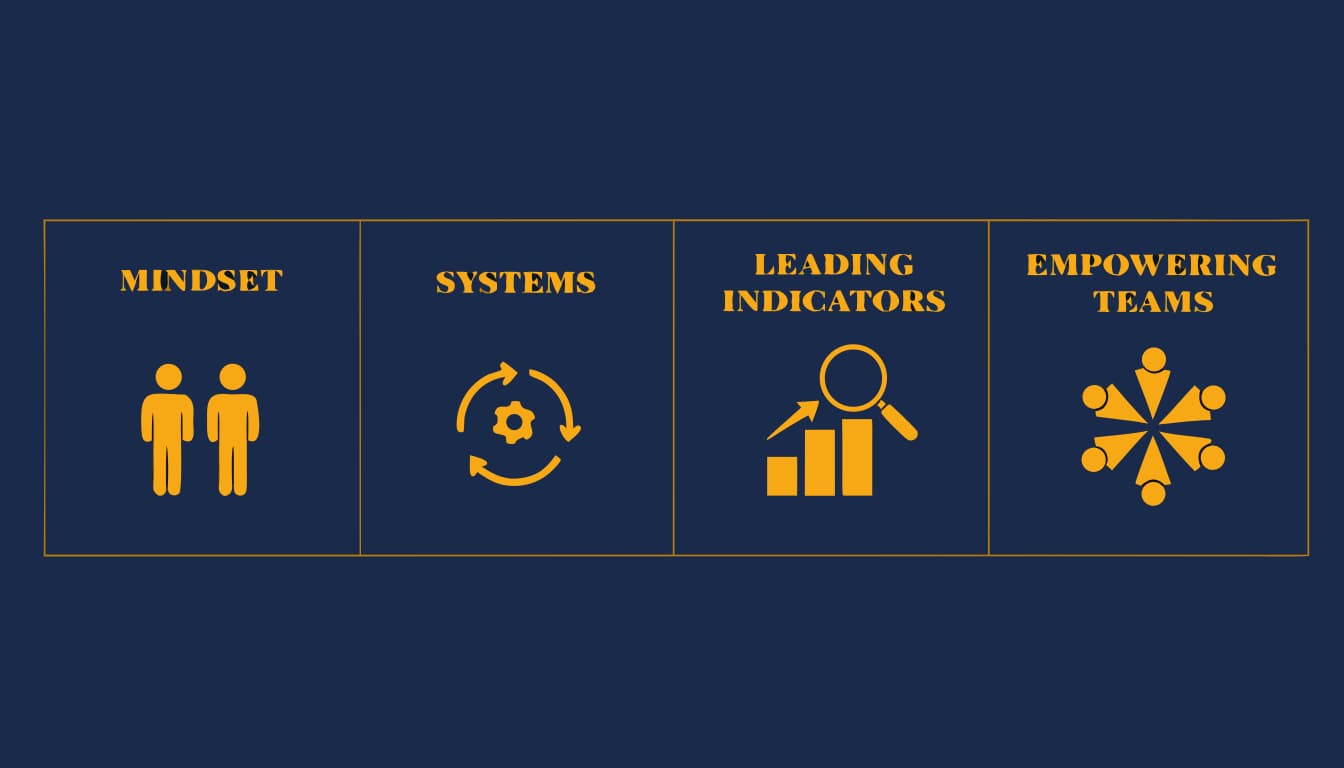
| Pillar | The "Margin Builder" Impact | What Changes For You |
| Mindset | Making the calls only the owner can make. | You stop being the bottleneck on every call |
| Systems | Building processes that don't depend on your constant presence. | You take two weeks off without a 2am call |
| Leading Indicators | Forward-looking metrics that predict your financial future. | You see the problem three weeks before your P&L does |
| Empowering Teams | Creating the conditions for your people to generate the ideas that drive performance. | Your best fix next quarter comes from the floor, not from you |
Questions owners ask
Isn't this what my operations manager should be doing? Yes, and that's the point. I don't run the operation. I make you and your managers into people who run the improvement system yourselves.
We already run EOS. Is this for us? Usually, yes. EOS gives you the meeting rhythm. I work on what happens on the floor between meetings: standards, a scoreboard the floor can see, coaching down to the lead hands, and ideas tracked to done.
Busier than ever and earning the same?
Thirty minutes will tell us whether a Margin Audit makes sense for your operation, and which company to start with if you run more than one.