
The Truck Order That Took Years (and the 4-Hour Fix)
Three years of meetings couldn't buy a $500,000 service truck. One room did.
I once did a project for a large electrical utility. This utility was responsible for generating and distributing electricity over a large area. The division I worked with was tasked with delivering the electricity that was generated.
Like all my clients, most people in the company wanted to do a good job. No one, or maybe 1 in a hundred, thought about how they could screw over the company the night before work. Quite the opposite, they thought about how they could do a good job.
One of my coachees was a division manager. Super nice guy, very efficient, and a good listener. I'll call him Roger, not his real name.
Roger's job was to ensure an entire district, which was quite large in area, was managed properly. This in large part meant making sure everyone was safe, budgets were met, jobs were done on time and capital equipment was maintained or replaced.
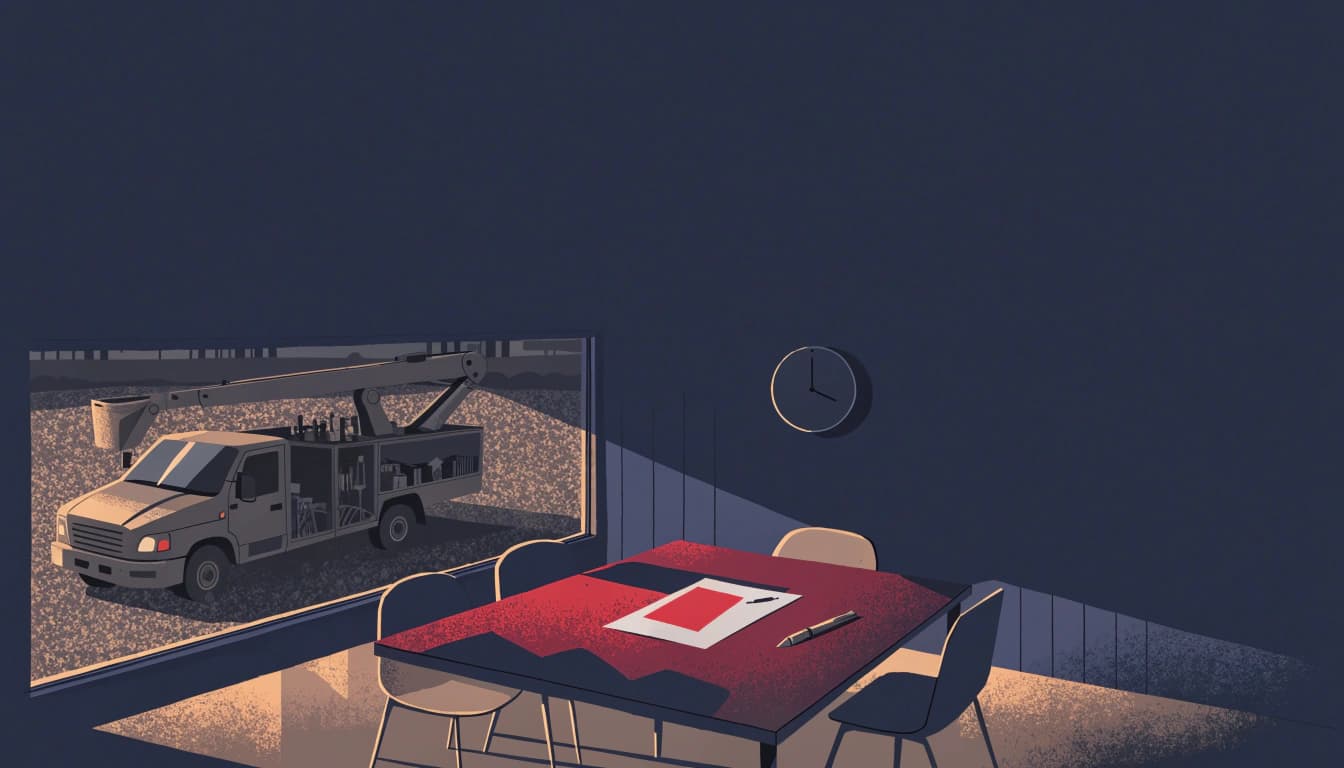
During a coaching session Roger mentioned how frustrated he was ordering a new $500,000 service truck. These trucks were custom kitted out to handle not only routine maintenance but emergency situations. There were lots of nooks and crannies, specialised tool cases, a crane etc. that had to be specified. He had been trying to order it for 3 years. Every time he had a meeting about it there was another question, or another requirement or a question about a question. Roger had meetings with his team, then engineering, then purchasing, then finance, then safety ... well, you get the idea. It went round and round. Every once in a while he would get close to a spec, have it quoted, put in the price and get more questions. Around and around again. One can understand Roger's frustration.
Not only did this burn up a lot of time, Roger's team was without a critical piece of maintenance equipment, which kept hurting the work completion metric. Roger was also concerned that when an event like a fire or storm hit, he would be without a critical piece of equipment to get power lines up and delivering electricity again. Roger figured the yearly maintenance delay was over $1 million and couldn't fathom a number if an emergency hit and equipment wasn't available.
I asked Roger what was the main problem ordering the truck. He told me it wasn't the spec. His guys sort of knew what they wanted, but each operator had a different opinion.
"How were you asking them?" I asked.
"1-on-1s. I wrote down notes, put them together and then distributed it to everyone. Then everyone would complain about something in the spec. And on and on it would go."
Then Roger realised something. He went, "Why don't I get all 4 people in a room and not let them out until they agree?"
"Why wouldn't you?" I asked. "What's preventing you from doing that?"
"Nothing," Roger said. "I am going to do just that."
That was Roger's action for that session.
Next time we met for a coaching session I asked Roger how the truck was coming along.
"Oh, the truck," Roger said. "We got it ordered. I got 4 people in a room, hammered out the spec and sent out the purchase order."
"Wow, how long did that take?"
"4 hours."
We both laughed. 3 years trying to buy a truck and Roger changed and got it ordered in 4 hours.
Roger had signing authority all along. Every comment the engineering, purchasing, finance and safety groups had made had already been heard. Once he had the operators in the room and a spec they agreed on, there were no more roadblocks when it came time to purchase. He'd spent three years asking for permission he didn't need. A lesson he would remember forever.
Bob Klein was Grumman's last chief engineer on the F-14. When the F-14 retired in 2006 he told Air & Space magazine how his team got a new targeting pod into the fleet in six months: "The best way to do something 'lean' is to gather a tight group of people, give them very little money, and very little time." Roger had the people and the money for three years. What he'd never given them was one room and a clock.
You might ask, "A truck is a capital purchase. You can't order the wrong truck, and forcing people to do it in an afternoon is crazy!"
Perhaps, but in this case 3 years didn't get a truck anyway. Get 4 people that know about what the job is, what the spec needs to be to get the job done, and you'll be surprised how quickly they come up with a spec.
Jeff Bezos drew that line for Amazon in his 2015 letter to shareholders. Some decisions are one-way doors — irreversible, so you take them "methodically, carefully, slowly, with great deliberation and consultation." Most aren't. They're two-way doors, and those "can and should be made quickly by high judgment individuals or small groups." His warning was aimed at big organizations: as they grow, they drift into running every decision through the one-way-door process. A truck spec is a two-way door — get a tool case wrong and you re-kit it. Three years treated it like a one-way door, and the result was the one thing worse than the wrong truck: no truck.
You don't need a large utility's organization chart to do this in your shop. The crane that's been "in next year's budget" for the past three years is the same issue that's been with the owner, the plant manager and the brother-in-law, who need to agree but never sit down all at once.
Find one thing in your shop that's been sitting around "in progress" for more than a year. Decide on 4 people that can figure out the solution. Then book 4 hours and don't leave the room without a purchase order.
I wrote about Ringelmann's tug-of-war numbers in August — the more people on the rope, the less each one pulls. A spec sheet works the same way.
To measure these decisions, don't track whether it gets done or not. Track how many people touched it and how many weeks the decision sat there. A shop where a truck takes three years is a shop where every decision is taking longer than it should. In Roger's case it's just the one he saw.
It took years to not order a truck. It took four hours to order one. The difference was the size of the room.
One next step: Next week, list every open decision older than 90 days. For each one, write the count of people involved. Pick the one with the most names and the least progress. Four people, four hours, Friday.
Further reading:
- 2015 Letter to Shareholders — Jeff Bezos (Amazon.com, Inc., April 2016; filed with the SEC as Exhibit 99.1). One-way doors and two-way doors — and why big organizations run every decision through the slow door.
- The Rowing Problem — Acend (Substack), June 26, 2026. Eight rowers are 74 seconds faster than one over 2,000 m.
- The Mythical Man-Month — Frederick P. Brooks Jr. (Addison-Wesley, 1975). Adding people to a late project makes it later. The 1975 version of a spec that goes round and round.