
Screwworm: Cure the Process, Not the Symptom
Two operators, ten years of blame, and a pile of new equipment that fixed nothing.
My first consulting gig was at a steel pipe manufacturing company. It was a dark, gloomy, dirty, and at the time dangerous place to work. I was brought in to improve general communication in the plant, with the ultimate goal of improving safety and output.
It was a union shop and the communication between leaders and workers was broken. Leaders were somewhat afraid of union leaders, and union leaders were somewhat distrustful of management. It didn't help that at the first meeting I went to, a V.P. from HQ started a management–union meeting off by saying, "You guys are a bunch of Fing idiots!"
In response the union members wore black t-shirts with a cobra snake on the front that said "You push, I bite."
Yikes! What a start to my consulting life.
Before I get into the story I am going to talk about the screwworm.
Why? Because it's a story about focusing on the process, not the people, to solve the problem.
You can read about the screwworm in Brian Potter's great post, The Fall and Rise of Screwworm.
In short, the story of the screwworm is horrific. Kind of like a dark steel pipe plant.
The screwworm is the only fly whose larvae eat living flesh. This caused horrific deaths among livestock like cattle in Texas. It was so bad ranchers almost gave up raising cattle.
To solve the problem, ranchers hired screwworm cowboys whose job was to pick off any screwworms they found on a rancher's herd.
The problem was it didn't matter. The more cowboys they hired to pick worms, the worse the problem got. It almost got to the point that the cost of cowboys exceeded the gross profit from the cattle.
It wasn't until two USDA entomologists, Edward Knipling and Raymond Bushland, decided to study the process of the screwworm life cycle that the problem was solved.
The solution?
Bombard a bunch of male screwworm flies with radiation, rendering them sterile. Introduce them into the population. Screwworm females only mate once, so that should reduce the screwworm population.
It worked, and ranching resumed profitably in the southern United States.
Now back to the steel plant.
There were many issues at the steel plant. Uptime was only 75%, which meant the plant was not operating 25% of the time. An unbelievable metric for me, coming from the plastics world where everyone freaked out if you dropped below 0.5% downtime.
One problem that came up was an issue between two operators. These operators were good, experienced employees with over 10 years' experience. One was in charge of an operation downstream of the other.
Over the years, when there was an issue — quality, maintenance, etc. — fingers were pointed between the two operators. The leadership team kept adding modernization equipment. Automatic scanner here, ultrasound there, etc. This did not affect throughput at all. This was just like the cowboys. One more scanner was like one more cowboy out on the range picking worms.
The problem, I soon found out, was that the two operators were not communicating. They hated each other. For over 10 years they had been blaming each other for the problem. I found this out by talking to each of them.
Now this may sound silly — why hadn't they talked before? There was a reason. The plant environment made it necessary to wear double hearing protection. You couldn't talk to anyone on the floor. Employees went hours between breaks without talking. When I went into the lunch room there was dead silence. No laughter, no teasing, no arguing, just silence. It was a cultural norm not to communicate.
The reason existed because no one had studied what was really going on. What the life cycle of the problem was. The equipment treated the wound, like the cowboys picked the worms. The PPE — hearing protection — was necessary, and therefore, like the fly, never questioned.
So my solution: get them in a room and have them talk to each other. Hash the problem out and have them come up with a solution.
When I told the leadership my plan to get the two workers together in a room with a whiteboard to figure out a solution, they freaked. You better get HR involved. This is a union issue. Hostility could break out, etc.
I said I would talk to HR about it.
I did.
They had similar comments and asked if I had formal conflict resolution training. I said "no," but that I had solution-finding training, and in my experience finding a solution made everyone happy. HR gave me permission to have the meeting and said "good luck."
I also went and talked to the shop steward. He was extremely open to the idea. "No one ever asks us how to fix things here. They just tell us."
You might be thinking the same thing the leadership team was thinking. The two operators would start fighting the first time I handed them a whiteboard marker. It was possible. But what was worse? They had already been swinging at each other with words for 10 years. Hopefully the whiteboard and markers would absorb those swings.
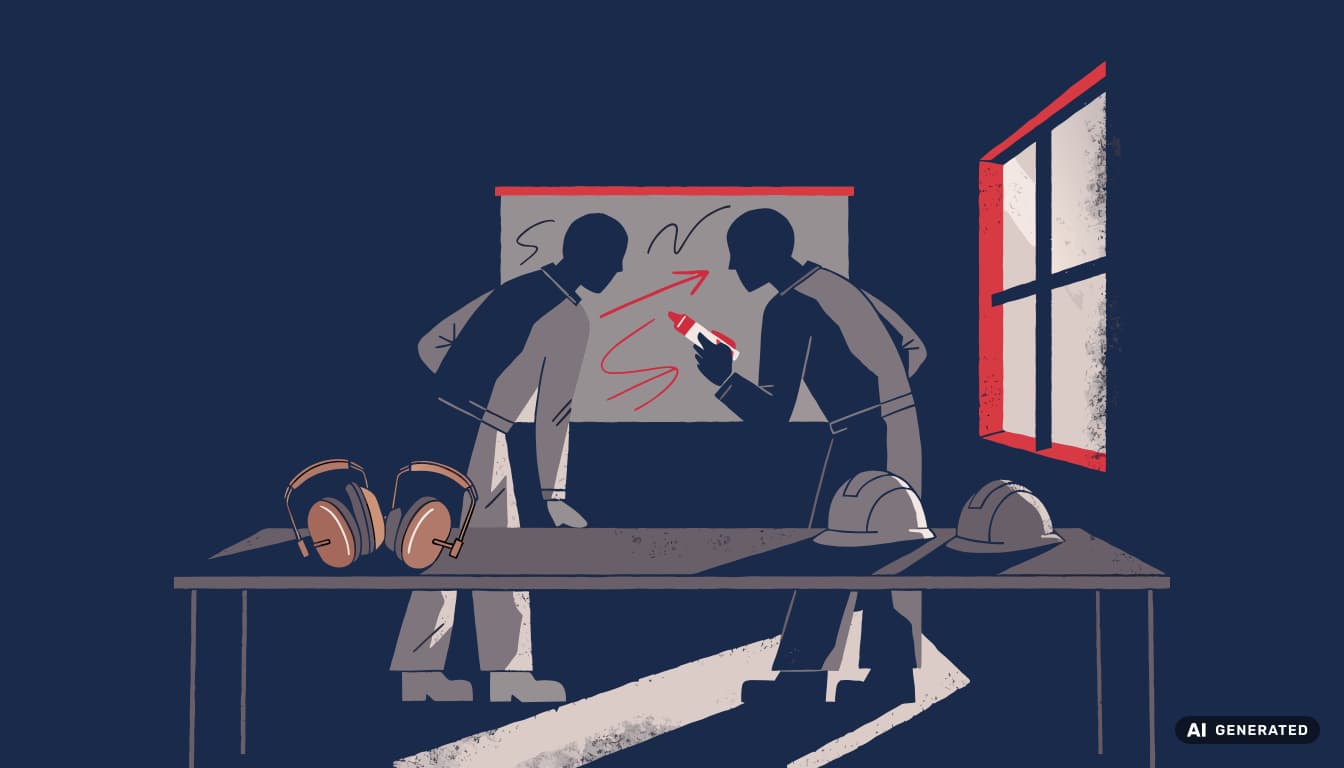
The easy part was the meeting. I got permission to get the two operators off the floor. We went to a quiet room with a whiteboard. I stood at the board and started asking open questions.
"What's going on?" and "What else?" and "What else?"
"What happens to the pipe when it leaves your station?"
"What would make your shift easier tomorrow?"
Instead of arguing with each other, they each answered the questions.
As they answered they got more excited. What if we do this? What if we do that? They were talking about reality and coming up with solutions.
They were working together.
The meeting took less than 1 hour and afterwards they shook hands and over time became friends on the floor. They even started talking at lunch!
I found out later the two had never talked for 10 years. Because of all their PPE they didn't even recognise each other when they first came into the room. The PPE was necessary of course, but no one ever addressed how it affected communication.
So the main message here is that instead of yelling at people and buying new equipment, simply breaking down the communication barrier and working through the process saved millions of dollars. Uptime went from 75% to 79%. Each percent was worth $10 million. A great return for 2 people off the floor for 1 hour.
Just like the screwworm, without the gore.
One next step: Think of a problem you have on the floor. What is it? Who is involved? Once you know that, get them together, ask open questions, keep your mouth shut and record their ideas. They want to help. All you have to do is listen.
Further reading:
- The New Economics for Industry, Government, Education (3rd ed.) — W. Edwards Deming (MIT Press, 2018). "No amount of care or skill in workmanship can overcome fundamental faults of the system." The two operators were skilled. The system never let them talk.
- It's Our Ship: The No-Nonsense Guide to Leadership — D. Michael Abrashoff (Business Plus, 2008). Don't blame people, blame the system — when something goes wrong, there's usually a missing system, not a stupid person.
- The Fall and Rise of Screwworm — Brian Potter, Construction Physics (Substack), July 3, 2026. The whole screwworm story, including how the cure lapsed when nobody kept minding it.