
It's Not About Sits and Stays
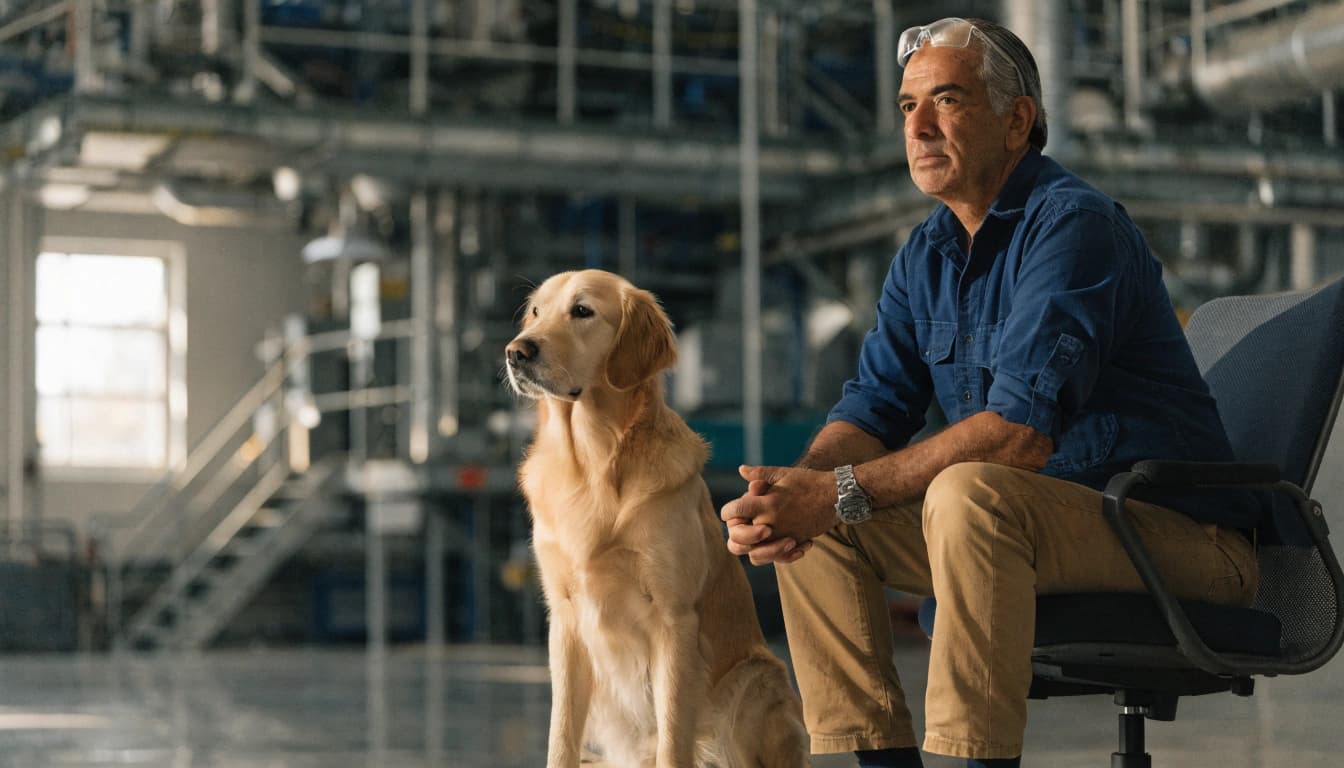
A few years back, one of our coaches pulled a senior leader aside and started explaining a coaching point using horse training as the analogy. The leader straightened up, looked him dead in the eye, and said — loud enough for the room to hear — "Are you calling me a horse?"
We weren't entirely sure if he was joking. Either way, we learned a useful lesson: set up the "why" before you reach for the metaphor.
So let me set up the why.
I am about to compare coaching humans to coaching dogs. I am not calling you a dog. I am not calling your team dogs. What I am saying is that the science of how behaviour is learned, reinforced, and sustained is remarkably consistent across mammals — and the leaders who understand that science get dramatically better results than the ones who don't.
If you bristle at the comparison, that's fair. Stick with me anyway. The payoff is a set of tools you can use on Monday morning.
My Sister Karen and the Healthy Hounds
My sister Karen runs an Instagram channel called Healthy Hounds (), where she helps people train their dogs. She's good at it. Over 12,000 people watch her work.
Every time we get together, the conversation drifts the same way. She'll describe how she got a reactive dog to settle in a noisy park, and I'll realize she's just described — almost word for word — what I do when I'm helping a plant manager get a frustrated supervisor to change how he runs his shift huddle.
The mechanics are the same. The vocabulary is different. The science underneath is identical.
Karen has a line she uses with her clients that stuck with me:
It's not about sits and stays. It's about the dog.
Translated for our world:
It's not about write-ups and reviews. It's about what the employee needs to succeed.
That's the whole article in two sentences. Everything below is the operating manual.
The Science You're Already Using (Whether You Know It or Not)
Both dog training and human coaching rest on the same foundation: operant conditioning. B.F. Skinner laid this out in Science and Human Behavior (1953), and the principle is brutally simple:
"Behavior is shaped and maintained by its consequences."
Behaviours that get rewarded increase. Behaviours that get ignored fade. Behaviours that get punished get suppressed — but often produce fear, avoidance, and a quiet resentment that shows up later in your turnover numbers.
Karen Pryor — the marine mammal trainer whose 1984 book Don't Shoot the Dog! is required reading in animal training programs and corporate behaviour consultancies — put it this way: "Reinforcement is the key to changing behavior, and it works across all species."
All species. Including the one that signs your paycheques.
Aubrey Daniels, who built an entire performance management consultancy on applying Skinner's work to the workplace, says it more bluntly: "People do what they do because of what happens to them when they do it." (Bringing Out the Best in People).
So if your team is doing things you don't want them to do, the uncomfortable question is: what are you reinforcing that you didn't realize you were reinforcing?
Five Tools You Can Use This Week
Five — because five is what you'll actually remember on Wednesday afternoon when you need them.
1. Be Clear, Not Clever
In dog training, if "down" means lie down on Tuesday and get off the couch on Wednesday, the dog isn't being stubborn. The signal is broken.
In leadership, this shows up as vague expectations, shifting priorities, and inconsistent feedback. Employees who look unmotivated are very often just uncertain.
Ask yourself: Would a new hire understand exactly what success looks like in this role this quarter? If the answer requires more than two sentences, you have a clarity problem, not a motivation problem.
2. Reinforce What You Want — Immediately
Karen Pryor's most-quoted principle: "The timing of reinforcement is critical. Delayed reinforcement reinforces the wrong behavior."
In her world, a reward delayed by even a few seconds teaches the dog the wrong lesson. In ours, we've institutionalized the delay and called it the annual performance review. A year-end recognition for great work in March is the management equivalent of giving the dog a treat next Tuesday for sitting last weekend. The behaviour and the reward have lost their connection.
Gallup's 2024 research with Workhuman makes this concrete: employees who receive feedback and recognition from their manager at least once a week are 61% engaged. Employees who get the feedback but rarely the recognition? Just 38%. Same managers. Same companies. The only difference is whether the timing and the reinforcement land together.
Tool: Praise specific behaviour within 24 hours of seeing it. Not "good job" — "the way you walked the new hire through the changeover today saved us at least an hour of rework. Thank you."
3. Shape Progress, Not Perfection
Complex behaviours — in dogs and humans — are built through small wins, not by waiting for the finished product.
A dog learning to retrieve doesn't get the full picture on day one. The trainer rewards looking at the ball, then touching it, then picking it up, then bringing it back two feet. Each step gets reinforced.
Translate this to a supervisor you're trying to develop into a plant manager. Most leaders wait until the supervisor is "ready" — which usually means until they've already figured it out alone. That's the slow path. The fast path is reinforcing each step toward the role: the first time they handle a customer escalation well, the first time they run a production meeting without you, the first time they hold a peer accountable.
Mindset: Progress builds confidence. Confidence builds performance.
4. Design the Environment
Trainers know something most managers under-use: you can't out-willpower a bad environment.
You don't ask a puppy to "just behave" in the middle of a dog park. You manage distractions, set up the space, and remove temptation. Behavioural science calls this choice architecture. Kurt Lewin captured it in 1936 with the formula B = f(P, E): behaviour is a function of the person and the environment.
If you want focus, eliminate the open-door interruptions. If you want collaboration, design workflows that require it. If you want accountability, make the metrics visible to everyone every day.
Tool: Pick one behaviour you're frustrated about. Ask, what about the environment is making the wrong behaviour easier than the right one? Change the environment first. Lectures second.
5. Know When to Stop Using Treats
This is where dog training and human coaching part ways — and where leadership gets interesting.
Dogs are mostly externally motivated. Treats, praise, play. That's the toolkit, and it works.
Humans run on something deeper. Daniel Pink, in Drive, makes the case that sustained human performance comes from three intrinsic drivers: autonomy (control over how you work), mastery (getting demonstrably better at something), and purpose (knowing why the work matters).
Pink's line is the one I keep coming back to:
"The secret to high performance is the deeply human need to direct our own lives, to learn and create new things, and to do better by ourselves and our world."
External rewards — bonuses, perks, public recognition — are excellent at starting behaviour. They are weak at sustaining it. If your retention strategy is the annual bonus, you've capped your team's ceiling.
Tool: For each of your direct reports, can you name one piece of autonomy they have, one skill they're actively mastering, and one piece of purpose they connect to? If you can't, that's the gap. And the gap is where your best people are quietly deciding whether to stay.
The Bottom Line
Both dogs and humans follow the same laws of behaviour. Humans add layers of meaning, identity, and purpose on top. The leaders who get the best out of their teams aren't using a different species of management — they're using the same laws of learning that every good coach, teacher, and trainer has used for a hundred years, and adding the human layer on top.
Most leaders use only one half of that equation. The dogs-only half — control, treats, the occasional swat with a rolled-up newspaper — produces compliance. The humans-only half — purpose statements and posters in the lunchroom — produces eye rolls. The leaders who combine both produce performance.
Karen had it right. It's not about sits and stays. It's about the dog.
Or in our case — it's about the people.
Now go fetch.
If you read this and thought "we have at least three of these gaps in our shop," that's exactly the kind of thing a Margin Audit uncovers — usually in 30 minutes. It's a free conversation, and we'll tell you straight whether the margin is hiding in your operations, your leadership system, or both. Reply to this email or .
Sources & further reading:
Skinner, B.F. (1953). Science and Human Behavior.
Pryor, Karen (1984). Don't Shoot the Dog!
Daniels, Aubrey (2000). Bringing Out the Best in People.
Pink, Daniel (2009). Drive: The Surprising Truth About What Motivates Us.
Edmondson, Amy (2018). The Fearless Organization.
Lewin, Kurt (1936). Principles of Topological Psychology.
Gallup & Workhuman (2024). Empowering Workplace Culture Through Recognition.
American Kennel Club. Operant Conditioning & Positive Reinforcement