
Delete Before You Automate
Musk's five steps, run on a roof drain seal years before he named them, and the two problems they didn't catch.
When I was a roofing contractor there was one thing that consistently bit me in the ass. Drain connections.
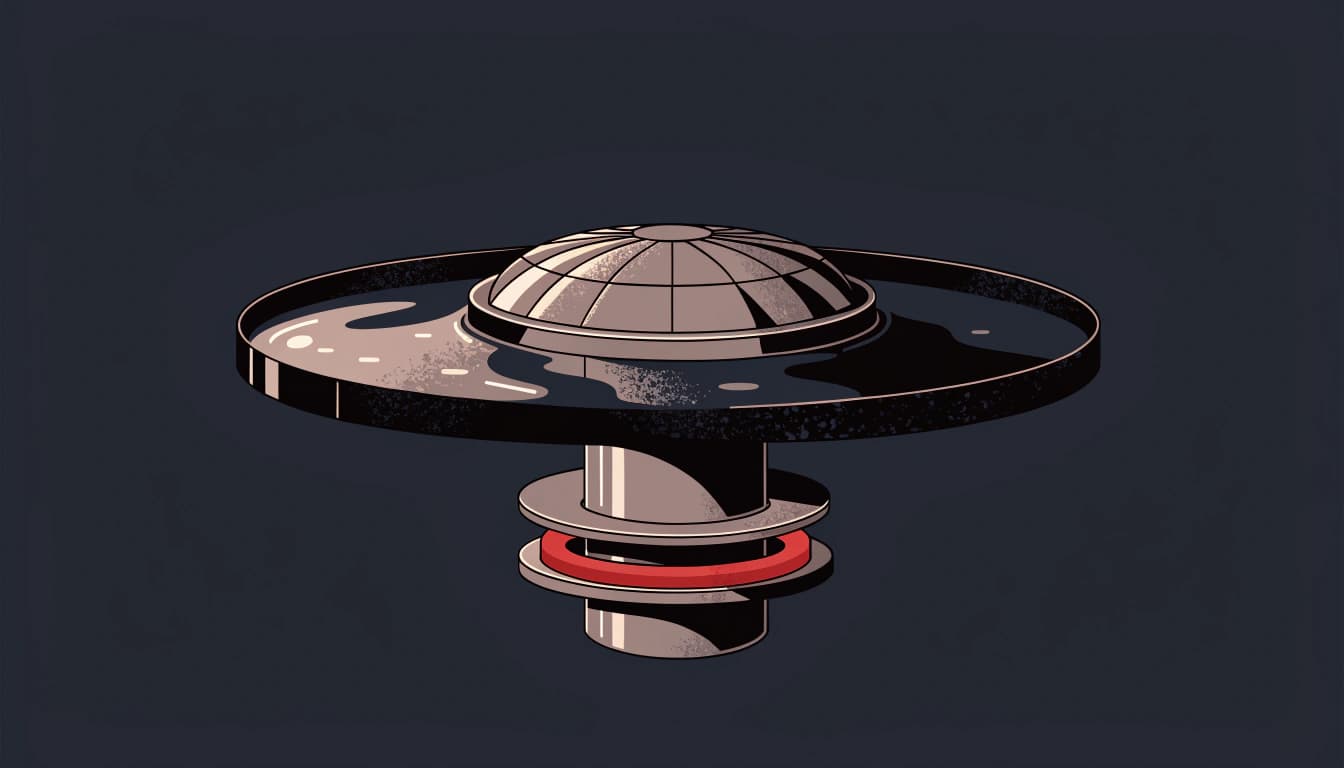
Roof drains look like floor drains with a raised strainer dome to keep out debris. They are often broken or rusted out during re-roofing. The common practice was to install a slightly smaller spun metal sleeve to fit inside the existing drain. The connection to the existing pipe was caulking. This looked beautiful from the roof top. All new and shiny, but it hid a fatal flaw. The caulked connection. Would you stick your home plumbing together with caulking? No, for obvious reasons.
This worked until a large rainstorm occurred causing water to back up and accumulate on the roof top. This was done on purpose to slow run-off rain water and reduce waste water pipe size and expense. The problem was the caulked drain seal would leak.
This happened at a job I supervised on a telephone switching building for a small town. Water entered the building, shorting out equipment and causing a telephone outage for the community.
All hell broke out and I was sent out to deal with the issue. Pretty quickly I realised the roof drain caulking had failed. I was talking with the roof designer and told him that the drain was installed to spec, but the spec wouldn't work.
On the drive home I came up with what became the "U-Flow Seal". A rubber gasket compressed by two flanges activated by screws.
The question was, "How was I going to make this?"
Years later I read about the way Musk builds things, and recognised the process we had stumbled into. Walter Isaacson wrote about this in his Musk biography. Musk repeats it so often it's become almost a mantra. The five steps are:
One. Question every requirement. Two. Delete any part or process you can. Three. Simplify and optimise. Four. Accelerate cycle time. Five. Automate.
That's it. But the order matters more than the steps themselves. Musk didn't invent any of this. Value engineering at GE in the 1940s questioned the function of every part. Toyota and Deming were saying "fix the process before you automate it" decades before Tesla existed. What Musk did was put the steps in a fixed order and repeat them loudly enough that people remembered. Most people start at step five. They try to automate first. Or they jump to step four and try to speed things up. Or they go to step three and try to optimise.
You're probably thinking this is a product story, and you don't build products. You run a shop, a crew, or a service yard.
Stick with me. The five steps are about process, and every shop has a process it has never questioned. Here is what it looked like on one small part, including the questions we asked and the ones we should have.
I didn't call it Musk's 5 steps back then but here is what we did.
Step One. Question every requirement.
The requirements were:
- Reliable seal to handle a 24 inch water column
- No water obstruction. Improved water flow would be even better.
- Fits inside 3 standard pipe sizes, 3", 4" and 6", and meets building code.
- Long lasting materials.
- Easy to install by a contractor without special tools.
We also settled who was in charge. Me. We didn't have money to hire a product engineer and I had practical roofing, and thus roof drain, experience.
Questions we didn't ask but should have:
- Does it need to be removable or serviceable? (We made it removable but that wasn't necessary.)
- Which requirements were inherited from a competitor's product rather than from the problem? (There was no previous seal, but there were many spun metal drains.)
Step Two. Delete any part or process you can.
- We deleted screws from 4 to 3 at smaller diameters.
- Thinned the plastic down.
- Tapered the rubber to improve performance and reduce cost.
- Made the screws smaller.
Other questions we could have asked:
- Why screws at all? Could compression, a wedge, or a cam do it? (Screws were required for various reasons.)
- Could the gasket be the body? Single-material part, no assembly. (Possibly, but at great expense.)
Step Three. Simplify and optimise.
- Added a long screwdriver to actuate the screws, making it simpler to activate the sealing.
Other questions we could have asked:
- Can the part be installed wrong? If yes, can the geometry make it impossible? (No, it can't be installed wrong.)
- Can it be installed blind, by feel, in a dark crawlspace? (Yes, but never seen this situation.)
Step Four. Accelerate cycle time.
We used Finite Element Analysis software to set up virtual 3D models and run them until optimised. This vastly sped up development time. For example, to get a part custom made would take weeks and a lot of money. FEA did the job in 24 hours. It does it in real time with today's computer power. Creating models was the slowest loop without FEA.
We communicated with contractors and suppliers to get immediate feedback.
Other questions we could have asked:
- Could we have 3D-printed test fits before cutting any tooling? (No, the technology was not available at the time.)
Step Five. Automate.
Worked with plastic moulding die engineers to automate the injection moulding process.
Purchased customised assembly and packaging equipment.
Other questions we could have asked:
- Which step, if automated, would remove the most human handling per unit? (We didn't do this at first but implemented it later.)
- Did we automate anything that should have been deleted in Step Two? (No, but great question.)
What the five steps didn't catch
As you can see, some of the questions we asked, some we didn't. It helped that we had contractor installation expertise, and FEA was a game changer.
We completed the steps and got our first batch of products. We started shipping them to customers. Even after all our planning we ended up facing two problems that nearly bankrupted us and were not caught by the 5 steps.
First, we had used nuts that were in the bottom flange. We used heat to slightly melt the plastic around them. They failed during installation. If a contractor put downward force on the screw it would pop the nut out and then spin and fail to tighten the seal. This was costly because we had to figure out a solution, which was ultrasonically welded inserts. This took time but also expensive tool changes and the purchase of ultrasonic welding machinery.
Second, we didn't understand the U.S. market. In Canada spun metal insert drains were common, so we did not include them with our seal. In the United States spun metal insert drains were not used and not known. So during sales calls we would get "Great product! But what do I connect it to?" It took a year to partner with a metal spinning manufacturer to produce drains to go along with our seals to satisfy the United States market. That almost sank us, but in year two sales took off. This was more a marketing issue than a technical one, but a question we added to our tool kit.
The five steps will get you a better part. They won't tell you whether the part gets installed the way you pictured, or whether the customer has anything to bolt it to. Those two questions are yours to add.
One next step: Pick one process in your shop this week and run it through Step One only. Write down every requirement, then next to each one write who asked for it. Any requirement without a name is a candidate for Step Two.
Further reading:
- Elon Musk — Walter Isaacson (Simon & Schuster, 2023). Where the five-step "algorithm" is laid out, in the order Musk insists on.
- The New Economics for Industry, Government, Education — W. Edwards Deming (MIT Press, 1993). The quality tradition Musk's delete-first sequence echoes and inverts.
- Bulletproof Problem Solving — Charles Conn and Robert McLean (Wiley, 2018). Structured decomposition: why order of operations matters in problem solving.