
Why not just use AI instead of a coach?
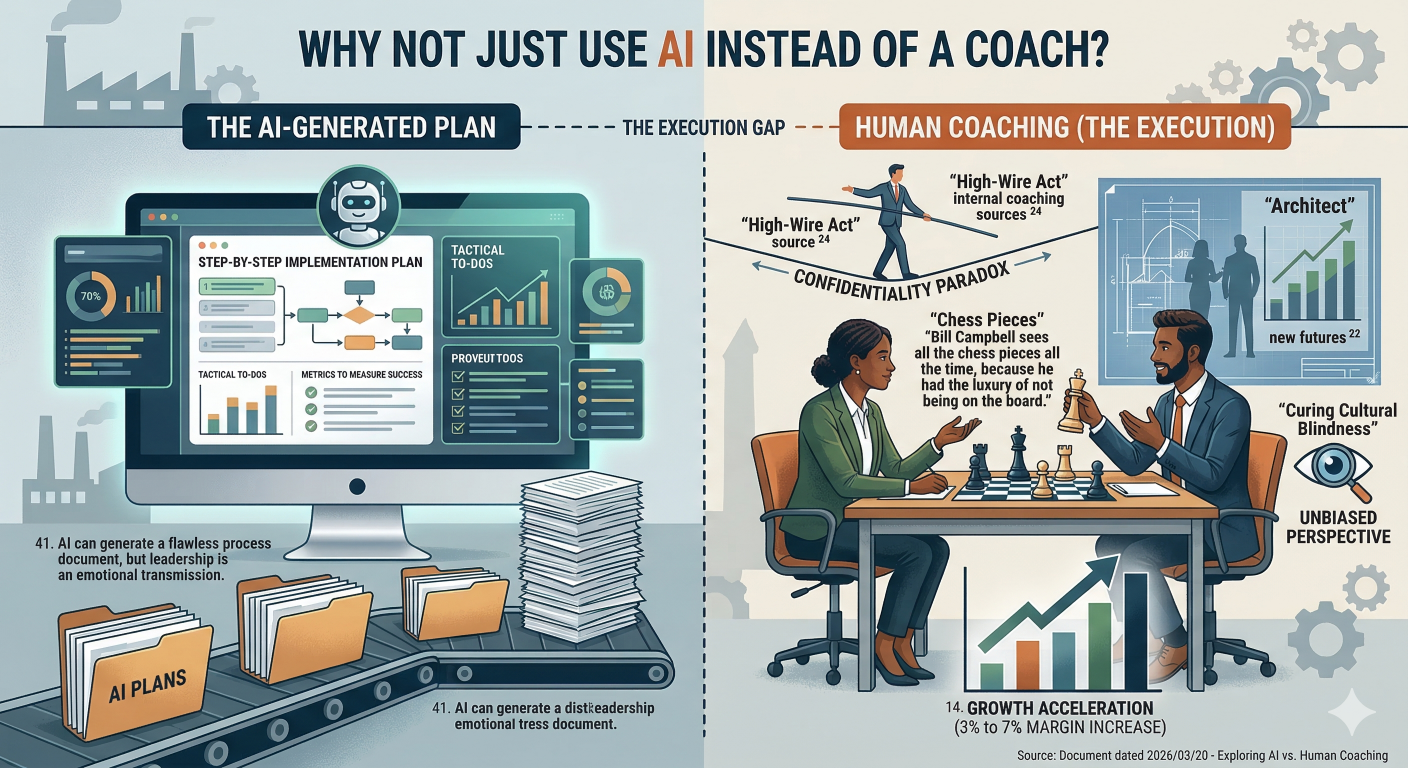
I sometimes get asked, and sometimes wonder myself, “Why not just use AI instead of a coach?”.
Right now, it is incredibly easy to use an AI agent and a simple English prompt to generate a step-by-step implementation plan for improving your team. Within seconds, the AI will give you tactical to-dos and metrics to measure your success.
But having a plan is not the same as executing it. While AI can hand you the tools, trying to pull off organizational change by yourself—or relying solely on an internal leader to act as a coach—is notoriously difficult.
Here is why relying on AI and internal coaching almost always falls short, and why hiring an external expert is the ultimate leverage for your business.
1. The Bandwidth Problem (and the Opportunity Cost)
Even if you understand and believe in the AI-generated implementation criteria, finding the consistent time to get it done is nearly impossible. If you are running a $5M to $50M industrial firm, you are in the "Squeeze Zone"—too big to manage everything by gut feeling, but too busy "doing the work" to build the systems that protect your bottom line.
Trying to be a full-time coach to your team while running operations drains your most precious resource: time. The opportunity cost is massive. If you are taking time away from the core business to learn and implement coaching models, how much profit are you losing?. By hiring an external performance management consultant, you can accelerate your growth and typically secure a 3% to 7% margin increase. In a $10M business, that is $300K to $700K; for a $50M business, it is $1.5M to $3.5M. You reach bottom-line mastery much faster when you don't have to do it all yourself.
2. The Skill Gap
You have tons of experience in your industry, but likely very little pure coaching training. Many managers incorrectly assume that "coaching" simply means telling people what to do. But true coaching is a structured, outcome-oriented process, not just giving informal advice or issuing top-down orders.
Professional coaches utilize proven frameworks (like TGROW or Prosci) that are often unknown or unpracticed by internal leaders. A coach's job is not to dictate, but to hold up a mirror to a leader's blind spots and act as an "Architect" who designs the conditions that make new futures possible.
3. The "Confidentiality Paradox"
Internal coaching is often described as a "high-wire act" because it forces employees to navigate a web of conflicting loyalties. The most significant hurdle is trust. Sometimes your people are afraid to tell you the truth—not because you are a bad person, but because you are the boss.
If an employee fears that admitting a weakness will leak into their performance review, they will self-censor. An external consultant acts as a neutral catalyst. When employees are hesitant to execute a bold new strategy, I often tell them, “Just tell them the crazy consultant said it was a good idea". That immediately takes the pressure off, allowing their confidence to build.
4. Associative Knowledge and Curing "Cultural Blindness"
You know exactly what is going on in your business, but you are "in the jar," which means you can’t always "read the label". Internal leaders often suffer from "cultural blindness" and implicit bias, unconsciously steering teams toward solutions that fit the current, comfortable status quo.
External consultants, on the other hand, work with many people across different industries, countries, and cultures. They bring all of these diverse, transferable skills together and apply them to your specific bottlenecks. As Patrick Pichette noted about legendary Silicon Valley executive coach Bill Campbell: "Bill saw all the chess pieces all the time, because he had the luxury of not being on the board".
5. Even the GOATs Need a Coach
In sports, even the "Greatest of All Time" have coaches. Michael Jordan didn't reach his peak alone; he hired Tim Grover because Grover presented a program that challenged traditional training and backed it up with results. In business, Bill Campbell—a former football coach—guided titans like Steve Jobs, Larry Page, and Eric Schmidt, proving that the best way to mold effective people into powerful teams is through dedicated coaching. You might not want to admit your fears to your boss (the head coach), but you can safely discuss them with a personal, external coach.
The Bottom Line
AI can generate a flawless process document, but leadership is an emotional transmission. When you walk into a plant, will a dashboard of AI-generated metrics listen to your team's fears? Will a robot inspire a struggling frontline worker to take ownership of a problem?.
True team cohesion comes from human connection, shared purpose, and psychological safety. It is incredibly hard to foster that environment when you are already drowning in the day-to-day demands of running a company.
You don't have to navigate the Squeeze Zone alone. Let's get to work and start building those margins. Visit www.themarginbuilders.com to learn how we can do the heavy lifting of performance coaching for you.
"Internal coaching is often described as a high-wire act." This document explores the "Confidentiality Paradox" and the idea that internal coaching is a high-wire act due to conflicting loyalties and the fear of weaponized vulnerability. It introduces the concept of "cultural blindness," explaining that internal leaders are "in the jar" and thus cannot read the label, making them subject to implicit bias.
Schmidt, E., Rosenberg, J., & Eagle, A. (2019). Trillion Dollar Coach. This book illustrates how former football coach Bill Campbell successfully guided tech titans like Steve Jobs, Larry Page, and Eric Schmidt. It provides the quote from Patrick Pichette, who noted that an external coach like Campbell "saw all the chess pieces all the time, because he had the luxury of not being on the board".
Grover, T. S. (2013). Relentless: From Good to Great to Unstoppable. This text supports the point that even the greatest athletes, like Michael Jordan, needed an external coach to take their physical performance to the ultimate level. It explains that Jordan hired Tim Grover because Grover presented an intriguing training program that challenged traditional methods and was backed by results.