
Four Crews, Same Job: 30 Minutes to 6 Hours. Why?
The slow crews weren't the problem. The silence between shifts was.
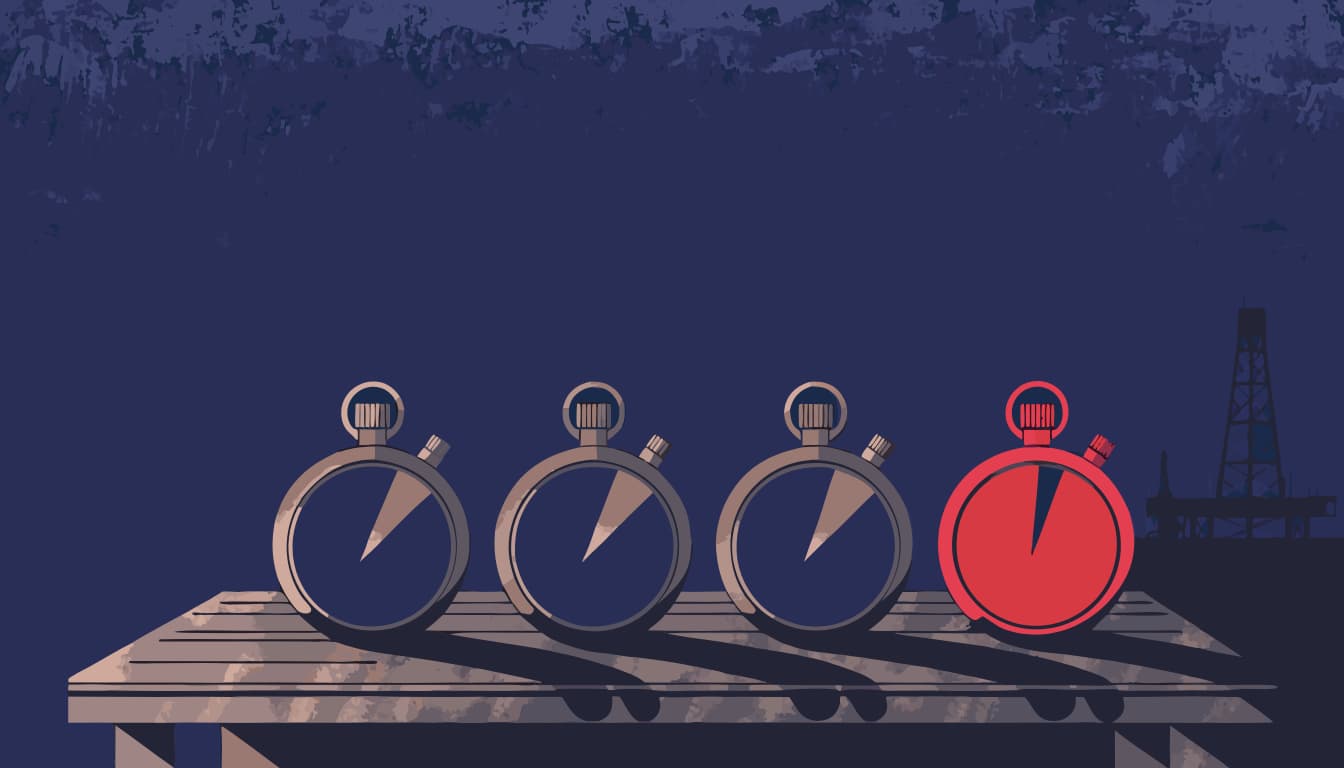
I once worked on the Alaska North Slope, on the oilfields called Prudhoe Bay near the Beaufort Sea. It was a beautiful, stunning and wickedly dangerous place to work. White in total darkness in the winter, and bursting with birds, bugs and vegetation in the 24 hours of never-ending daylight in the summer.
My job there was twofold: improving safety on the rig and improving drilling performance. The safety part I'll talk about later. It was important because if the rig had too many safety incidents it would be banned from working. This would be an $18 million loss to the drilling company if that happened. I'll talk about that in another article. What I'll write about today is the second part of my job. Improving drilling performance.
Safety and performance go hand in hand. For example, when Cynthia Carroll took over Anglo American's mines, she shut down the world's biggest platinum mine over safety. Fatalities fell 62% — and the company posted the highest operating profits in its history. Amy Edmondson tells the whole story in The Fearless Organization. If you are working safely, processes are in place, worksites are clean and organized, and proper checks are done.
One of the things you analyse when on a project is the time it takes to do various tasks. Then you rank them from most time to least time, and then difficulty to reduce the time. The "low hanging fruit" exercise. When I did this on the rig, one of the things that cropped up was the time to nipple down the BOP stack — uncoupling the blowout preventer stack from the wellhead.
When I was running comparisons on disconnecting the BOP stack, which needs to be done before the rig can move, the times varied widely, from 30 minutes to 6 hours. At $25,000 rig cost per day, a 6-hour variance across roughly 50 stack disconnects a year would cost $25,000/4 × 50 = $312,500 per year.
Why?
To find out why, I talked to each of the crews' Tool Pushers (Foremen), and learned a few things.
First, none of them talked to each other. Not because they didn't want to but because of the nature of shift work. They rarely got together at the same time. Also, stack disconnection occurred randomly. It wasn't a daily process. So each crew was assigned the task at random times.
Because of these constraints there was no talking about best practices.
Second, they didn't know their disconnect times. No idea. They just did the work each time the best they could.
Third, these Tool Pushers and crews were good people. They took pride in their work, supported each other, were extremely safe and liked to learn.
W. Edwards Deming put it plainly: "Life is variation." The question he taught managers to ask is the one that mattered on that rig: "What is the variation trying to tell us about a process, and about the people that work in it?" The 30-minutes-to-6-hours spread wasn't a crew problem. It was a system problem — four good crews, cut off from each other, with no data.
So the question is: how do we fix this variance problem?
You're probably thinking your crews already talk to each other. Or that nobody has time to sit down and document a job they've done a hundred times. That's exactly what makes this kind of variance invisible — every crew is doing the work the best way they know how, and nobody can see the gap.
The first thing I did was provide the BOP Stack disconnect data to each crew. Each crews performance. Not to blame, but to inform.
Then I created process sheets for each crew. I worked alongside them and took notes. There was no blaming, just recording.
We then took the 4 processes together and created a master process sheet.
I went around to each crew a few times and iterated the process until everyone agreed that it was the best.
This needed to be done because of the shift issues.
In a couple of months, all 4 crews were doing stack disconnects in 30 minutes. This saved over $300,000 annually. But not only that — more importantly, it taught the rig manager and Tool Pushers the power of collaboration, sharing data, asking questions and trying things out until they were performing optimally. It's a skill that would remain after I left. Not just a one-off improvement. They could use this skill everywhere.
As an added benefit, the process became safer, because there were fewer steps involved. Fewer steps means fewer places where something can go wrong.
The other big lesson was not to blame anyone. No one came to work on the day thinking, how can I screw my team over? They thought the opposite: how can I safely improve the operation today?
The beauty of this is, as managers, we can control this process. It's easy and doesn't cost millions in equipment and software.
This is the same move a Margin Audit makes — hunting the variance in how your teams actually execute, the way I wrote about in The $10M Efficiency Gap.
So, question to you: what processes are you performing that could benefit from the team giving their input?
One next step: Pick one task that more than one crew or shift performs. Time it this week — every crew, every time it happens. Don't fix anything yet. Just put the numbers side by side and show them to the people doing the work.
Further reading:
- The New Economics for Industry, Government, Education — W. Edwards Deming (MIT Press, 1993). Deming on variation: a 30-minute-to-6-hour spread is a system crying out for study, not a crew to blame.
- The Signal and the Noise — Nate Silver (Penguin Press, 2012). On reading variance as signal — and how easy it is to think you've found the answer when you're just describing the noise.
- The Fearless Organization — Amy C. Edmondson (Wiley, 2018). The Anglo American story: how a hard line on mine safety cut fatalities 62% while the company posted the highest operating profits in its history.