
Don't Stop. Open the Floor.
The rejected order didn't break us. What we did in the next hour decided who we became.
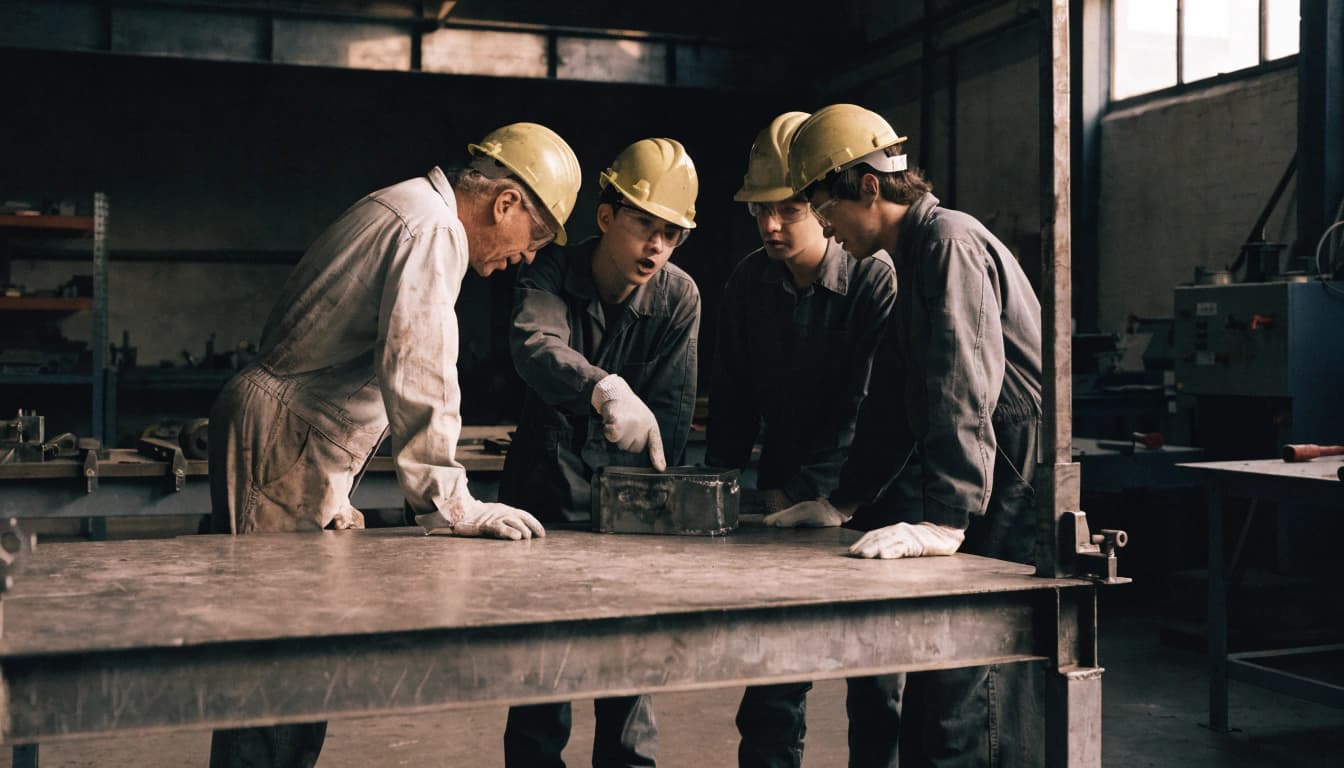
Years ago, at a specialty manufacturing company I ran, we welded an order using a part we'd specified ourselves — and the part was too thin. We knew it was borderline. We welded anyway. We shipped it.
The customer rejected the whole order.
There's a particular silence that falls over a floor when that call comes in. Everyone hears about it within the hour, and everyone does the same private math: the rework, the lost time, the customer we might never get back. You can feel the crew waiting to see which way the room is going to tip. Toward "this one's blown, let's cut our losses." Or toward something else.
That moment — not the bad part, not the rejection, but the hour right after — is where resilience actually lives. And it's the most misunderstood moment in leadership.
The setback isn't the test. The next hour is.
Most owners think resilience is about absorbing the hit. Taking the rejection, the blown schedule, the failed run, and gutting through it on willpower. Tough it out, work the weekend, survive.
That version of resilience has a fatal flaw: it ends with you. You become the only load-bearing wall in the building. The operation holds together exactly as long as you're personally holding it up — and the day you're not in the room, the floor tips the wrong way without you.
There's a better version, and it showed up in what happened next at that company.
We didn't cut our losses. We swapped in a thicker part, reordered, and restarted the job. But the part that mattered wasn't the decision to keep going — it was how we kept going. Instead of me dictating the fix from the office, the team jumped in. People who didn't normally speak up started floating ideas. We listened, we picked the ones that worked, and we implemented them fast. It took time to win that customer back. But the order got done — and something more durable got built.
Because everyone had been in it, the whole crew came out the other side believing something they hadn't quite believed before: when this place gets hit, we don't fold. We figure it out. Together.
That belief is the asset. Not the recovered order — the recovered order was a one-time win. The belief is what shows up the next time the ground shifts.
The question transformational leaders ask
When something breaks, the natural question is: how do I get through this?
It's the wrong question, because the answer is always "you." The better one — the question that separates a tough operator from a transformational one — is this:
When the ground shifts, what is my crew learning about how to stand on it?
Every setback is a live training session whether you intend it or not. The crew is watching to learn one thing: what do we do here when it goes wrong? And whatever you model in that hour becomes the muscle memory they reach for the next time — including the times you're not there to lead it.
So the job isn't to be the strongest person in the crisis. It's to build a crew that doesn't need you to be.
We proved that twice. The second time, it wasn't even a crisis — it was a wall.
We needed plastisol, a liquid PVC, to bond to aluminum so that flexible PVC could be heat-welded to an aluminum flange. On paper, simple. In reality, it fought us for months. Primer after primer, method after method, failure after failure. The kind of slow grind that quietly kills projects because nobody wants to admit how long it's taking.
Same move as the welding disaster: don't stop, open the questioning to the whole team, listen, implement. Months of shared R&D later, we cracked it — and produced the only product that actually held up in the field. A genuine success, out of a problem that had every reason to die on the bench.
Acute crisis or slow-burn wall, the behavior was identical. And that's the tell: resilience isn't a mood you summon for emergencies. It's a practice you run the same way every time something gets hard.
Four behaviors that build resilience in your crew
1. Refuse the verdict.
A setback delivers a fact — the part's too thin, the bond won't hold — but the crew will read it as a verdict unless you say otherwise out loud. Your first job is to separate the two. "This is a problem we solve," not "this is how far we got." The rejected order felt final until somebody decided it wasn't. That decision is yours to make first, and the crew can't make it until you do.
2. Open the floor — especially to the people who don't usually talk.
The instinct under pressure is to narrow: the boss decides, the senior people execute, everyone else stays out of the way. Do the opposite. The best ideas in both of those U-Flow problems came from widening the circle, not tightening it. When you genuinely open the questioning to the whole crew, you get more solutions and you tell every person in the room that their head is worth something here. That's the moment a team stops working for you and starts working on the problem.
3. Listen like rank doesn't apply.
Opening the floor is theater if you only act on ideas from the usual voices. Resilient teams are built when the newest operator floats something and watches it actually get implemented. Listening without rank is the hardest of these four because it costs your ego something — sometimes the best idea isn't yours. But every time you visibly take a frontline idea and run with it, you're teaching the floor that speaking up changes things. That's what makes them speak up next time, before the problem gets expensive.
4. Implement fast, and let the team own the win.
Ideas that sit don't build resilience; ideas that ship do. Move quickly from "good thought" to "let's try it," and when it works, make sure the credit lands on the people whose idea it was — not on you. The welding recovery became a team-builder precisely because everyone was in it and everyone shared the outcome. Resilience compounds when people see their own fingerprints on the comeback. Hoard the credit and you've taught them the opposite lesson: why bother.
What the rejection actually built
Here's the part I'd leave out if I were trying to look good: that welding disaster happened before we had ISO 9001 or any formal quality system in place. The too-thin part got out the door because we didn't yet have the standards that would have caught it.
But the rejection is what drove us toward those standards. The setback didn't just cost us an order — it built the system that made sure it couldn't happen the same way twice. That's resilience doing its real work: not just recovering from the hit, but converting it into something structural that protects you going forward. The bad day becomes the reason the operation gets better. If you debrief honestly — what made this happen, what do we change — every setback pays you back with a system.
Widen the stage
Misty Copeland started ballet at thirteen — an age the discipline considers far too late — and became the first African American woman named principal dancer at American Ballet Theatre. She has every reason to talk about resilience as a personal triumph. Instead, she talks about it as something you build for others.
In a recent TED Talk, she framed resilience not as being unbreakable or pretending the pain isn't there, but as moving through it with purpose and holding on to calm long enough to keep going. The line worth pinning above your desk, though, is what she said about her larger purpose — making the stage wide enough for others to step onto, so they can discover their own resilience and store it for the moments they'll need it most.
Widen the stage. That's the whole job.
Opening the floor to a rattled crew after a rejected order is widening the stage. So is handing a frontline operator's idea the resources to become the fix. You're not just solving today's problem — you're showing your people how a team stands when the ground shifts, so that next time it shifts and you're not in the building, somebody else knows how to stand.
As Copeland puts it, resilience is a skill we can all draw on, one that belongs to anyone, anywhere, whenever it's needed. A skill. Not a temperament. Which means it gets taught — and on your floor, you're the one teaching it, every time something breaks.
Something will break again. The order will get rejected, the bond won't hold, the schedule will slip. The question was never whether you can get through it. You can; you always have.
The question is what your crew learns about how to stand while they watch you decide not to fold.
This week: Think back to your last real setback — a rejected order, a failed run, a wall you couldn't get past for weeks. Replay the hour after the bad news. Did you narrow the circle and carry it yourself, or open the floor and let the team build the fix? That hour taught your crew what this place does when it gets hit. Decide what you want the next one to teach them.
References & Further Reading
Misty Copeland, "The Roots of Resilience," TED (December 2025). The talk behind this piece, where Copeland reframes resilience as a learnable skill rather than an innate trait. Also released on the TED Talks Daily podcast as "How I Found Resilience Through Artistry." Watch: ted.com/talks/misty_copeland_the_roots_of_resilience
Amy C. Edmondson, *The Fearless Organization* (Wiley, 2018). The foundational work on psychological safety — why crews that fear blame hide the information that solves the problem. Underpins the "open the floor" and "listen like rank doesn't apply" behaviors.
The Margin Builders helps Alberta industrial SMEs turn operational discipline into measurable EBITDA improvement. If you've got talent on your floor you suspect you're not getting full value from, that's exactly the kind of thing a Margin Audit surfaces.